The Physical Internet
Who controls the infrastructure through which African digital activity moves?
- Internet traffic
- Data centres
- Submarine cables
- Cloud hosting
- Internet Exchange Points
- Last-mile broadband
PanAfriWoke Intelligence Report
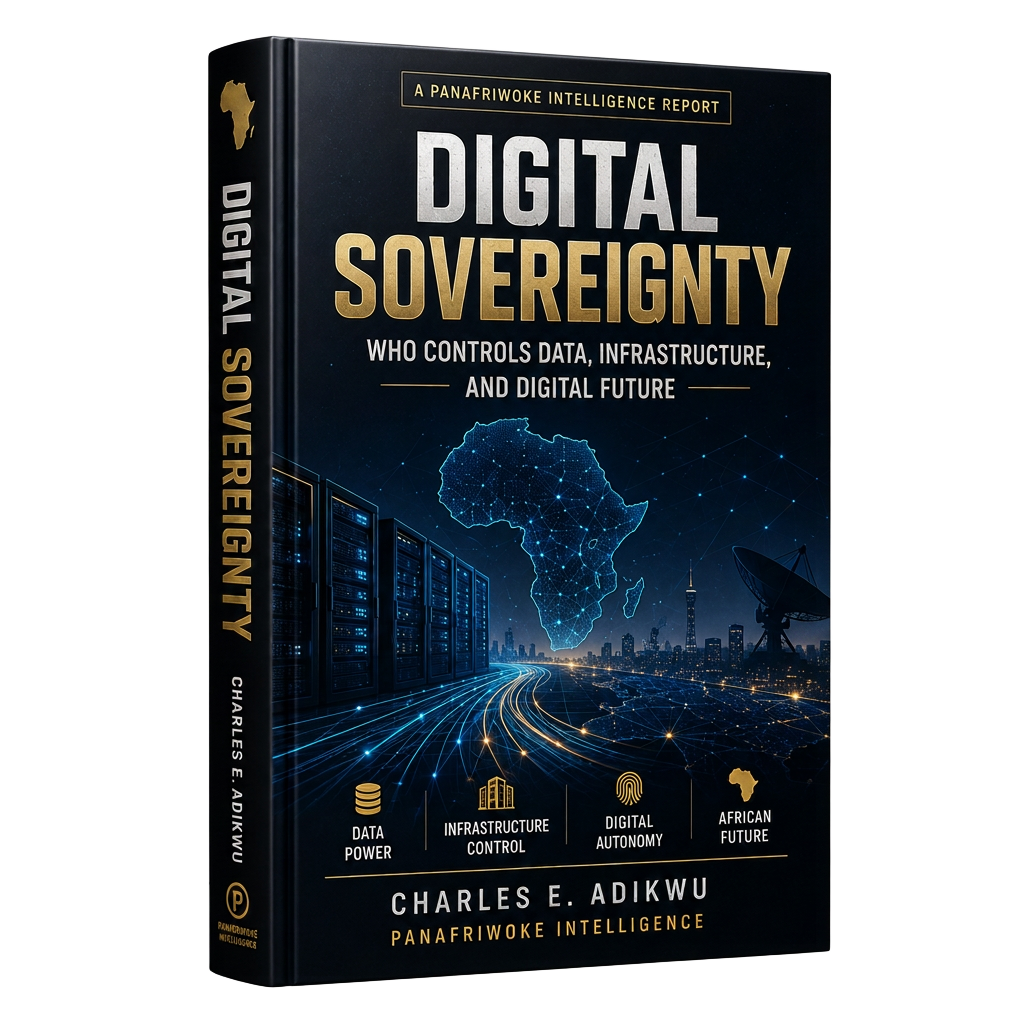
Digital Sovereignty
Who Controls Data, Infrastructure, and Digital Future
Digital infrastructure is no longer merely a technical layer beneath modern life. It is an economic, political and strategic system through which data moves, money settles, identities are established, public services operate, knowledge is produced and artificial intelligence learns.
Digital Sovereignty examines the systems through which African digital life passes—from physical connectivity and cloud infrastructure to AI, data, payments, digital identity, cybersecurity and public digital infrastructure—and asks the harder question:
Does growing digital participation give Africa greater bargaining power, or can it deepen dependence on infrastructure, platforms, capital and intellectual property controlled elsewhere?
A PanAfriWoke Intelligence technology and geopolitical research report by Charles E. Adikwu. International buyers: your checkout will show the applicable payment/currency options through Selar where available.
The Question
A country can have millions of internet users while depending heavily on infrastructure owned, financed, hosted or governed elsewhere.
African entrepreneurs can build globally competitive companies while relying on foreign cloud, payment and technology infrastructure.
African universities can train talented researchers while lacking affordable access to advanced computing.
African citizens can use mobile phones and digital identities while having limited visibility into how their data is collected, transferred, stored and processed.
The report examines the infrastructure beneath digital participation—and the capacity required to make strategic choices rather than have those choices determined by dependency.
Editorial Diagram
What the Report Examines
The report does not treat Africa's digital challenges as isolated technology problems.
Infrastructure, data, AI, payments, identity, cybersecurity, regulation, skills and capital are interconnected.
Who controls the infrastructure through which African digital activity moves?
Who produces, controls and benefits from the data and intelligence used to build AI?
How does digital value move across African economies?
Who controls the systems through which Africans become digitally visible?
Can critical African digital systems remain operational, secure and accountable?
What would a coherent African digital sovereignty architecture require?
Conceptual Framework
A conceptual framework from the manuscript — not a statistical chart
Digital Sovereignty
Infrastructure
Fibre / Cloud
IXPs / Satellites
Data
Governance
Privacy
Finance
Payments / Capital
Local & regional settlement
Conceptual Frameworks
The report examines the infrastructure, institutions, data governance, financing, skills and regulatory systems that determine whether digital participation becomes strategic capacity.
Conceptual equation
What You'll Learn
Why the physical location and ownership of digital infrastructure matter to cost, latency, resilience and jurisdiction.
Why data, language, compute, research capacity and intellectual property all matter to African AI sovereignty.
Why payment infrastructure and local-currency settlement affect how digital economic value moves across borders.
Why digital identity can expand inclusion while also creating serious privacy, security and governance risks.
Why cybersecurity, cloud dependence and public digital infrastructure are questions of state capacity as well as technology.
Why digital sovereignty is not one technology or one policy, but an ecosystem of infrastructure, data, finance, skills, regulation and institutions.
Inside the Report
Who controls the systems through which Africa's digital future is built?
Internet traffic. Data centres. Submarine cables. Cloud hosting. Internet Exchange Points. Last-mile broadband.
African languages. Data annotation. Genomic data. Copyright. Compute infrastructure.
Creator payments. PAPSS. Local-currency settlement. Crypto and stablecoins. Payment gateways. Remittances.
Digital identity. Encryption. Social-media algorithms. Data scraping. Satellite internet regulation.
Government portals. Cyberattacks. EdTech. Critical infrastructure. Public records.
Interoperability. AI and compute. Payment sovereignty. Digital sovereignty framework. Sovereignty scorecard. Strategic implementation.
The Core Idea
Digital sovereignty cannot be achieved by building one data centre or launching one payment platform.
It requires coordinated capability across infrastructure, data, skills, regulation, finance and institutions.
The objective is not digital isolation. It is the ability to participate in the global digital economy from a position of greater bargaining power.
Readership
Why This Report Is Different
The report is structured as an intelligence investigation rather than a conventional technology textbook.
It begins with visible digital problems and follows them toward the deeper structural questions behind them.
Verified Data
Claims supported by credible sources.
Illustrative Example
Concrete cases used to clarify wider issues without treating one example as universal proof.
Investigative Claim / Question
Issues that require further scrutiny rather than being presented as settled fact.
Strategic Analysis
Interpretation of what the evidence means for African policy, business, technology and institutional strategy.
The Publication
Who Controls Data, Infrastructure, and Digital Future
By Charles E. Adikwu
PanAfriWoke Intelligence
What You Receive
International buyers: your checkout will show the applicable payment/currency options through Selar where available.
Editorial Integrity
The final evidence edition distinguishes verified data, illustrative examples, investigative claims and strategic analysis.
The report's evidence base prioritizes authoritative institutional, technical and academic sources and clearly qualifies claims that vary by country, technology, institution or year.
About the Report
Author
Charles E. Adikwu
Publisher
PanAfriWoke Intelligence
Africa's digital future should not merely be connected to the world. It should be capable of negotiating with the world.
Digital Sovereignty
Who Controls Data, Infrastructure, and Digital Future
Charles E. Adikwu
PanAfriWoke Intelligence
International buyers: your checkout will show the applicable payment/currency options through Selar where available.
Continue the Investigation
Digital Sovereignty, Economic Power and the Struggle for African Control
View Report — coming soonTreaties, Contracts, Borders, and the Fight for Sovereignty
View Report — coming soonHow Africans Abroad Can Turn Citizenship, Capital, Skills, Land and Political Power into African Influence
View Report — coming soon